'%20d='M32%203C16.4%203%206%2015.3%206%2031.2c0%2010.9%206.6%2020.1%2014.3%2026.2L32%2077l11.7-19.6C51.4%2051.3%2058%2042.1%2058%2031.2%2058%2015.3%2047.6%203%2032%203Zm0%2014c-8.8%200-14.5%207-14.5%2016.4V55h29V33.4C46.5%2024%2040.8%2017%2032%2017Z'/%3e%3cpath%20fill='%23C99B4A'%20d='m27.5%2055%204.5-24%204.5%2024h-9Z'/%3e%3c/svg%3e)

The pub’s story
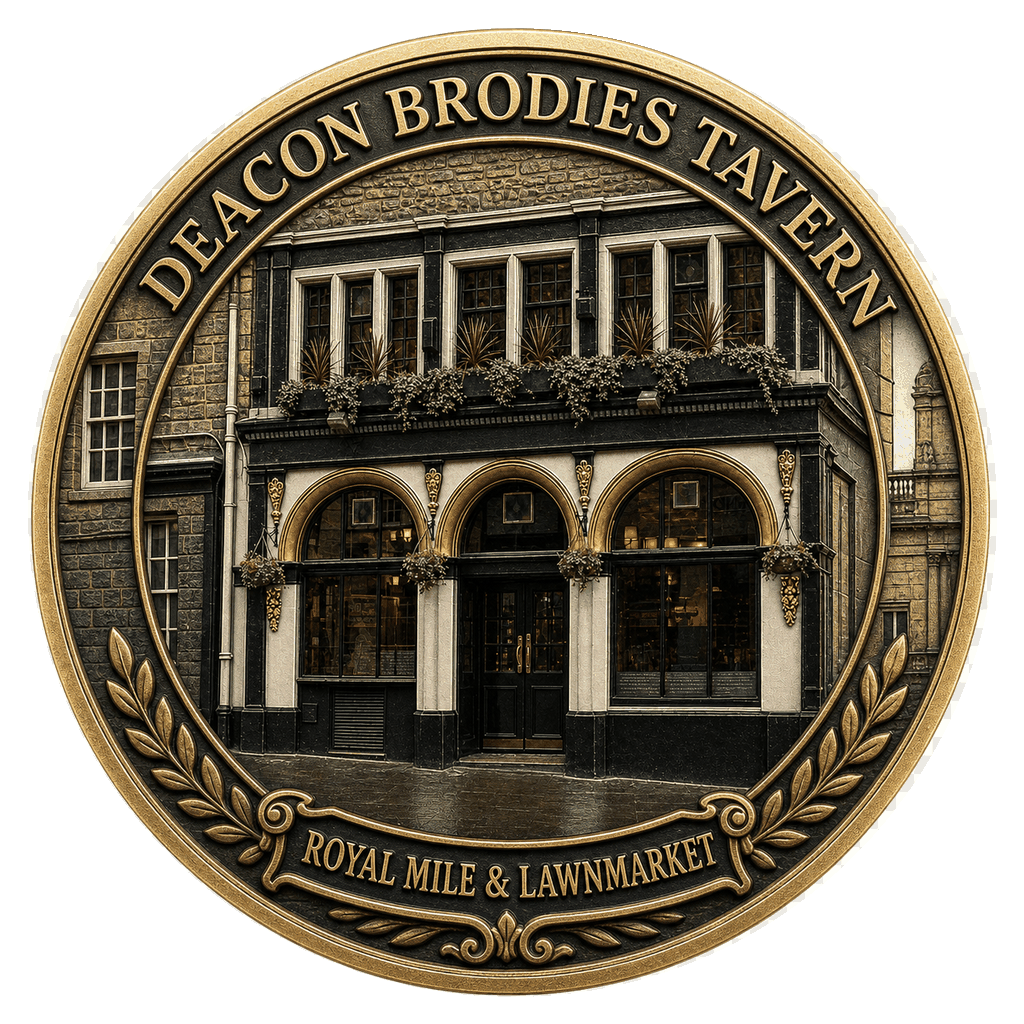
Deacon Brodies Tavern occupies an early eighteenth-century Lawnmarket building whose ground and first floors were altered into a public house in 1894. Historic Environment Scotland’s record is the anchor here: it separates the older building from the later pub conversion, a useful correction to the operator’s simpler 1806 marketing date. The tavern takes its name from William Brodie (1741-1788), the Edinburgh cabinetmaker, councillor and burglar whose double life helped shape Robert Louis Stevenson and W. E. Henley’s play Deacon Brodie. Brodie’s case is also often linked to Strange Case of Dr Jekyll and Mr Hyde, but the relationship is an influence rather than a one-to-one biography. The pub commemorates him; it is not documented as Brodie’s own drinking place. Look beyond the busy Lawnmarket frontage for the decorative timber, plasterwork and bar fittings recorded in the listed-building description. Today it is a walk-in city-centre pub serving Nicholson’s British pub classics, pies, whisky, gin and cask ale. It can be lively, especially at peak visitor times.
Literary connections
Each note states whether the link comes from a writer’s own words, a fictional setting, a commemorative name or a venue tradition.
William Brodie
18th century; later literary adaptation
Brodie’s documented double life as a respectable craftsman and a criminal is the basis of the tavern’s name. It was material for Stevenson and Henley’s play and is often considered one influence on Stevenson’s Jekyll and Hyde; that influence should not be treated as a simple one-to-one account.
- Gothic Edinburgh Robert Louis Stevenson website’s cautious account of Brodie as an influence on Stevenson’s gothic Edinburgh.
- The Writers’ Museum Edinburgh Museums’ description of the Brodie-made cabinet and cautious ‘may have inspired’ Jekyll and Hyde context.
- William Brodie National Galleries biographical account of Brodie’s real double life.
Deacon Brodie, a play by Robert Louis Stevenson and W. E. Henley
1880
Stevenson and Henley turned Brodie’s life into a play. The tavern is named for the historical man, while the play gives the literary link visitors can follow from this Royal Mile address.
- Three Plays (1892) Robert Louis Stevenson website record for the Stevenson/Henley play Deacon Brodie.
- Deacon Brodie: the novel National Library of Scotland contextual account of Stevenson, Brodie and later fictional retellings.
Robert Louis Stevenson
19th-century Edinburgh; present-day Royal Mile route
The pub is a useful Royal Mile stop for the Stevenson/Brodie story, with the Writers’ Museum and Makars’ Court nearby on the walk to the next venue. This is a thematic geographical connection, not evidence that Stevenson drank in this pub.
- The Writers’ Museum Official nearby museum context for Stevenson and the Brodie-made cabinet.
- Deacon Brodies Tavern Current operator account of the tavern’s Brodie/Stevenson interpretation.
What to notice
- 01
Read the frontage as a real address, not a film set: the black fascia and gold ‘DEACON BRODIE’S TAVERN’ lettering sit below the older stone building.
- 02
Inside, look for the decorative ceiling and fixed bar fabric noted in the listed-building record; their history belongs to the building, not to every story told about Brodie.
- 03
The venue says it operates walk-in only because it is very busy; the first-floor dining room host manages waits.
- 04
This is a historic, multi-level Old Town property. No specific step-free route has been verified for this guide, so contact the pub directly if accessibility is important.
- 05
Food is available from the operator’s current British pub-classics menu; menu availability and allergens should be checked directly.
The time rail
The building, the pub and its interior may date from different periods. The timeline keeps documented dates separate from tradition.
The present Lawnmarket building is described by Historic Environment Scotland as early eighteenth century.
William Brodie, the cabinetmaker and later criminal after whom the tavern is named, was born.
Brodie was executed; the documented life later became material for literary and theatrical retellings.
P. L. Henderson altered the ground and first floors to form a public house.
Hurd carried out a later recorded alteration phase.
The building was listed at Category A by Historic Environment Scotland.
Nicholson’s operates Deacon Brodies Tavern at 435 Lawnmarket; visitor details were checked on 18 August 2026.
Sources & confidence
Historic Environment Scotland is the primary source for the early-eighteenth-century building, Category A designation and the 1894 public-house conversion; the operator’s 1806 construction claim is not used as a building chronology. The official current venue page verifies identity, address, phone, hours, food and walk-in policy. The Robert Louis Stevenson website, Edinburgh Museums, National Library of Scotland and National Galleries support the literary context, but the Jekyll and Hyde link is deliberately described as an influence, not a one-to-one biography. No source reviewed documents the tavern as William Brodie’s own drinking place. Image is a cleaned, source-led rendering of a current reference photograph; the physical façade and full fascia name were retained.
Research reviewed
- 435 Lawnmarket, Deacon Brodie’s Tavern (LB29227)Historic Environment Scotlandheritage
SupportsAuthoritative building identity, Category A status, early-eighteenth-century date, 1894 P. L. Henderson public-house alteration, 1950 Hurd work and surviving architectural/interior description.
- Deacon Brodies TavernNicholson’s Pubsofficial
SupportsCurrent operator, address, phone, daily opening hours, current British pub-food and drinks offer, and the operator’s Brodie story. Its 1806 building claim conflicts with HES and is not used as the public chronology.
- Book a table at Deacon Brodies TavernNicholson’s Pubsofficial
SupportsCurrent walk-in-only policy and first-floor dining-room wait management.
- Deacon Brodie’s Tavern, EdinburghCampaign for Real Alespecialist
SupportsSpecialist current pub listing and a source-led exterior reference used to check the identity and fascia of the approved portrait.
- Gothic EdinburghRobert Louis Stevensonofficial
SupportsCautious literary context connecting Brodie’s double life with Stevenson’s gothic work.
- The Writers’ MuseumEdinburgh Museumsgovernment
SupportsOfficial museum context for Stevenson and the cabinet made by Brodie; uses cautious language about influence on Jekyll and Hyde.
- Deacon Brodie: the novelNational Library of Scotlandarchive
SupportsLibrary context for Brodie, Stevenson and later fictional retellings.