'%20d='M32%203C16.4%203%206%2015.3%206%2031.2c0%2010.9%206.6%2020.1%2014.3%2026.2L32%2077l11.7-19.6C51.4%2051.3%2058%2042.1%2058%2031.2%2058%2015.3%2047.6%203%2032%203Zm0%2014c-8.8%200-14.5%207-14.5%2016.4V55h29V33.4C46.5%2024%2040.8%2017%2032%2017Z'/%3e%3cpath%20fill='%23C99B4A'%20d='m27.5%2055%204.5-24%204.5%2024h-9Z'/%3e%3c/svg%3e)
The pub’s story
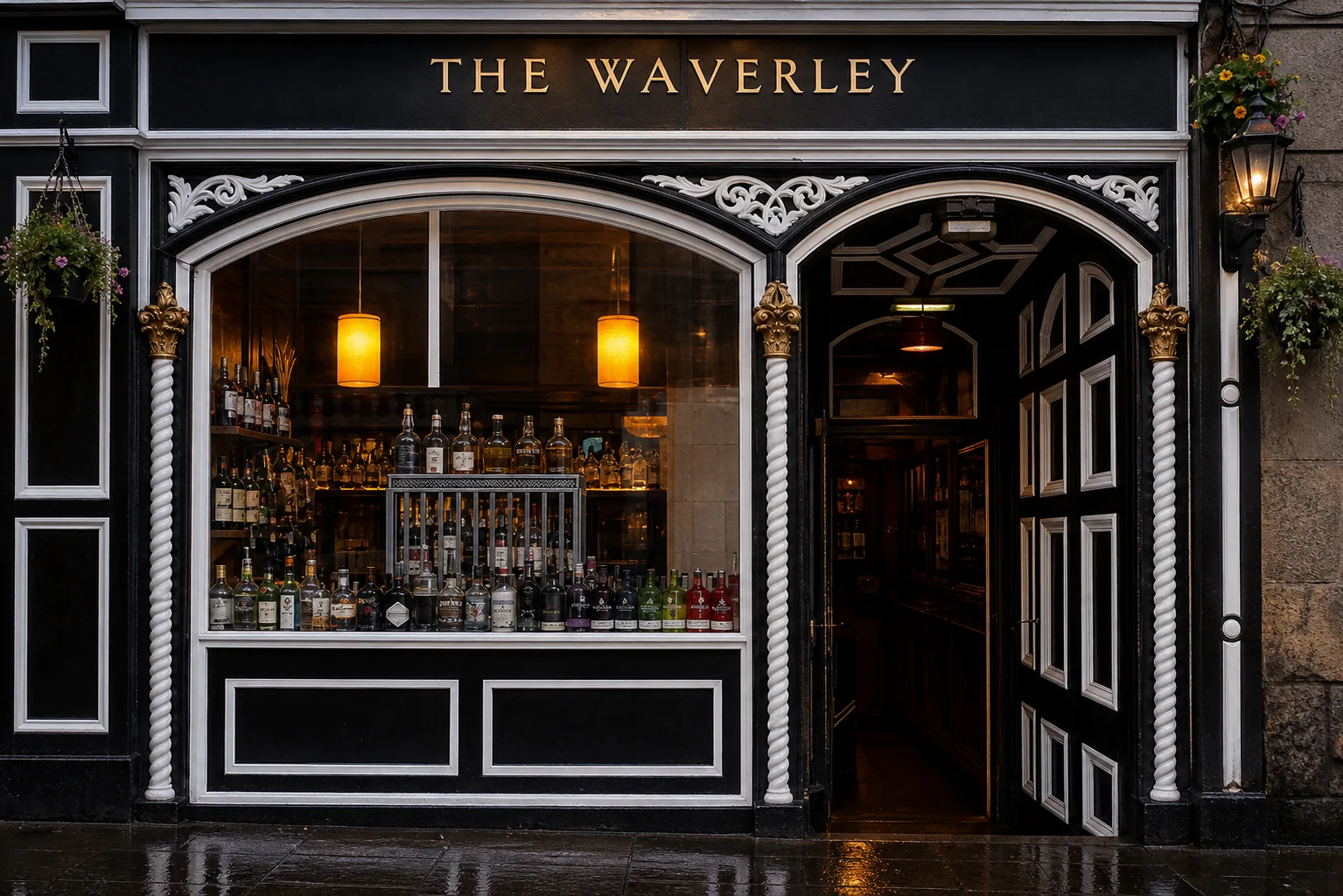
The Waverley Bar’s strength is living culture as much as its fabric. It occupies a late-eighteenth-century St Mary’s Street tenement with an unusually well-preserved 1891 pub frontage by R. Thornton-Sheills & Thomson: barley-sugar mullions, dentilled cornice and Bacchus-head consoles are real listed-building features, not invented Victorian styling. The Walker family says it opened the bar in the 1920s; that is retained as an operator attribution. A better-documented story begins in the late 1980s, when Guid Crack storytelling sessions started here alongside the Scottish International Storytelling Festival. Traditional Arts and Culture Scotland also records its folk-venue role and four generations of Walker family association. After owner Ian Walker died in 2015, the pub closed for a time; the current custodians say it reopened in May 2017, and Guid Crack returned in 2018. It remains a pub with a working storytelling legacy rather than a literary prop.
What to notice
- 01
The black-and-white 1891 frontage is genuine listed fabric; look for the barley-sugar mullions and Bacchus-head consoles.
- 02
The 1920s founding and Flodden-wall connection are operator claims, while the late-eighteenth-century tenement and 1891 frontage are independently documented.
- 03
Guid Crack’s storytelling history is a real tradition; check current listings for whether a session is actually happening.
The time rail
The building, the pub and its interior may date from different periods. The timeline keeps documented dates separate from tradition.
The listed tenement at 3-11 St Mary’s Street was built, surviving later Old Town clearance schemes.
R. Thornton-Sheills & Thomson created the distinctive public-house frontage at 3-5 St Mary’s Street.
The operator says the Walker family opened the bar in this decade.
Guid Crack storytelling sessions began at the Waverley as the Scottish International Storytelling Festival was starting up.
Owner Ian Walker died and the pub closed for an extended period.
The current operator says the pub reopened under new custodians after gentle restoration.
Guid Crack returned upstairs at the Waverley for its monthly storytelling sessions.
The operator continues to publish the bar’s current identity and weekly hours.
Sources & confidence
The operator provides the family, exterior and interior account; CAMRA and Forever Edinburgh corroborate the current venue and canonical 3-5 address, while TRACS independently documents Guid Crack and four-generation continuity. The 1891 date and Flodden Wall claim remain attributed because primary architectural evidence was not located.
Research reviewed
- The Waverley BarThe Waverley Barofficial
SupportsCurrent identity, address, published weekly hours and visitor-facing bar information.
- HistoryThe Waverley Barofficial
SupportsOperator’s 1920s Walker-family claim, folk-story context, 2017 reopening, displayed 1891/Flodden-wall narrative and interior character.
- 3–11 St Mary’s Street (LB30165)Historic Environment Scotlandheritage
SupportsLate-eighteenth-century tenement, Category B status, 1891 public-house frontage by R. Thornton-Sheills & Thomson, Bacchus consoles and Old Town sanitary-improvement context.
- Edinburgh, 3, 5 St Mary’s Street, Waverley InnTrove / Historic Environment Scotlandarchive
SupportsHistoric-environment record classifying the location as an eighteenth-century public house and preserving archive images of the Waverley and Bacchus heads.
- Waverley, EdinburghCAMRAspecialist
SupportsCurrent 3-5 St Mary’s Street venue record and dated August 2024 exterior evidence.
- Guid Crack returns to Waverley BarTraditional Arts and Culture Scotlandspecialist
SupportsLate-1980s origin of Guid Crack at the Waverley, folk-venue role, four-generation Walker association, 2015 closure and 2018 return.