'%20d='M32%203C16.4%203%206%2015.3%206%2031.2c0%2010.9%206.6%2020.1%2014.3%2026.2L32%2077l11.7-19.6C51.4%2051.3%2058%2042.1%2058%2031.2%2058%2015.3%2047.6%203%2032%203Zm0%2014c-8.8%200-14.5%207-14.5%2016.4V55h29V33.4C46.5%2024%2040.8%2017%2032%2017Z'/%3e%3cpath%20fill='%23C99B4A'%20d='m27.5%2055%204.5-24%204.5%2024h-9Z'/%3e%3c/svg%3e)
The pub’s story
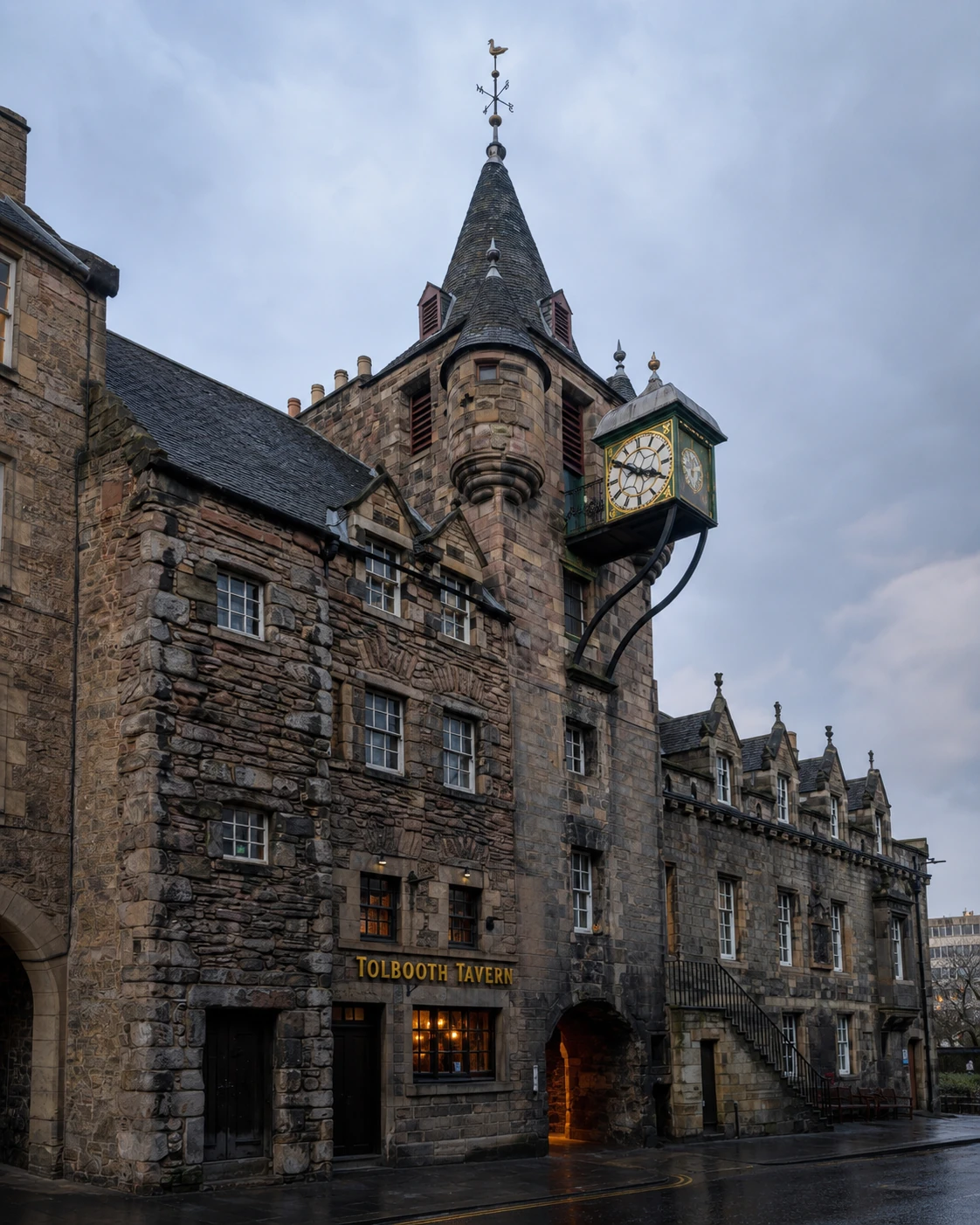
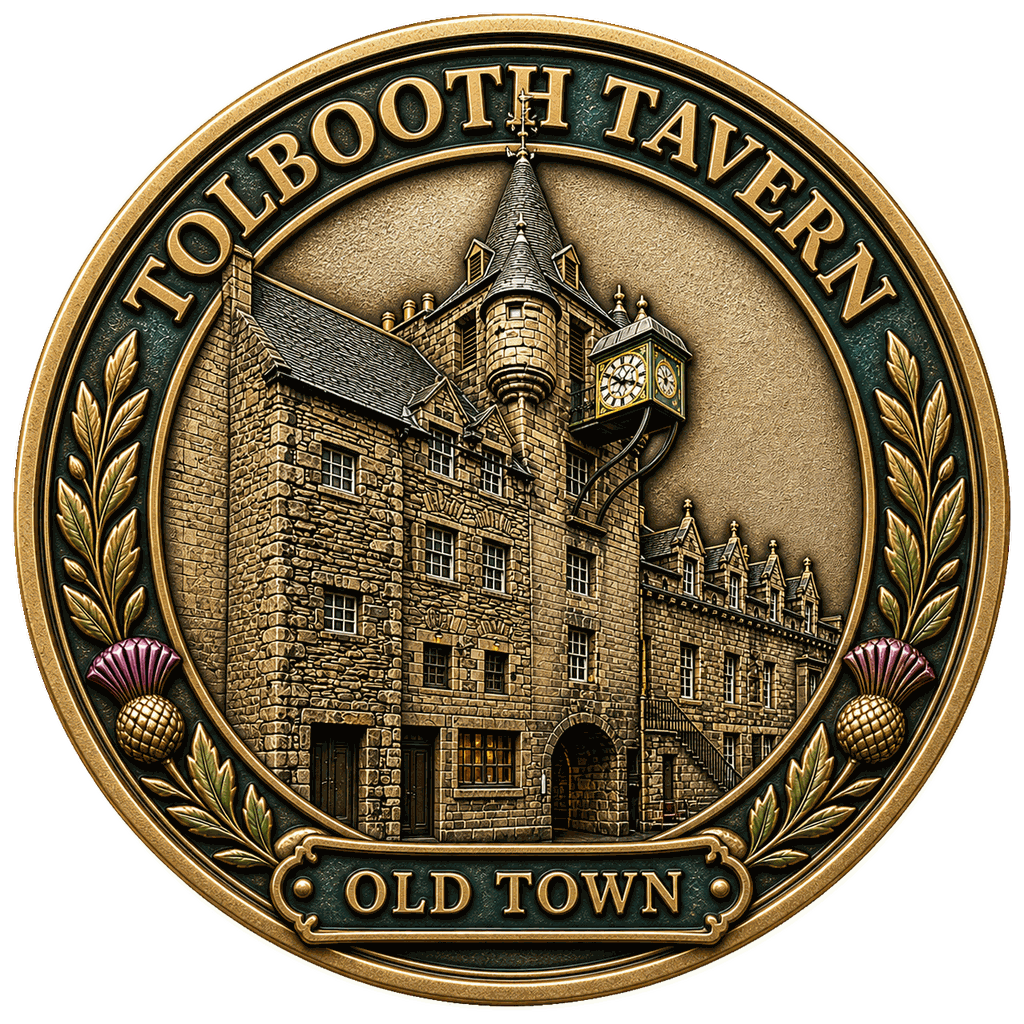
On the Canongate, Tolbooth Tavern occupies the ground floor of the category A-listed early-17th-century building at 167-169, beside the 1591 Canongate Tolbooth. The older civic building was commissioned by Sir Lewis Bellenden and served the separate burgh as council chamber, courthouse and jail. Its tower, pend and bartizans survive, but the familiar street picture is layered: Robert Morham restored the frontage in 1879 and HES dates further work, including the projecting clock, to 1884. The 167-169 building was extended rearward for housing around 1750. HES and the venue say a public house was established in 1820, yet no checked archival licence or directory proves that opening, so the date remains attributed. The venue alone says the rear rooms joined the tavern about a century later; that claim is likewise attributed. Ground-floor interiors have been largely refurbished, while early panelling and painted ceiling fabric survives principally in upper museum rooms. This is civic architecture adapted to hospitality, not an unchanged sixteenth-century tavern.
Film and television details
Each entry separates the real venue from its fictional role and states which part of the site was filmed. Scene notes avoid major spoilers.
Frankenstein
The Tolbooth Tavern frontage formed part of the atmospheric Canongate street set used for Guillermo del Toro’s Frankenstein. The venue describes a small on-screen role; no interior filming is claimed.
Filming footprint: Surrounding street only
- Tolbooth Tavern celebrates on-screen role in Guillermo del Toro’s Frankenstein The venue’s own account of its frontage and the Canongate appearing in the production street set.
Nearby screen locations
These are separate filming or historical locations. They are not extra pub listings, and they do not show that filming happened inside this venue.
- Royal Mile / High StreetPublic outdoor locationHigh Street between North Bridge and St Giles
Avengers: Infinity War 2018
The Royal Mile forms part of the wider Edinburgh action geography. This record does not imply that every building on the street appeared.
Avengers: Infinity WarFast & Furious 9 2021
Film Edinburgh includes the Royal Mile in its official F9 location list.
Fast & Furious 9Frankenstein 2025
The Royal Mile and Canongate were dressed as a period street set during filming in September 2024.
Frankenstein (2025)Sunshine on Leith 2013
The official movie map follows Yvonne through St Giles and the High Street.
Sunshine on Leith Movie MapAccess: Public street with steep gradients, crowds, setts and frequent event restrictions. Use crossings and keep closes and business entrances clear.
- Bakehouse ClosePublic outdoor locationBakehouse Close, 146 Canongate
The Adventures of Greyfriars Bobby 2005
Bakehouse Close appears in Film Edinburgh’s official location list for the film.
The Adventures of Greyfriars BobbyOutlander 2017
Bakehouse Close was used for Alexander Malcolm’s print-shop setting in season three.
OutlanderAccess: A narrow historic close with uneven setts and working cultural premises. Access can change for events; keep entrances and the passage clear.
What to notice
- 01
Read the site as two linked listed components: the 1591 civic Tolbooth at 163 and the early-17th-century pub building at 167-169 Canongate.
- 02
Separate the surviving tower, pend and bartizans from the restored 1879 frontage and the clock associated with 1884 work.
- 03
Do not mistake the largely refurbished ground-floor pub for early panelling and painted ceiling fabric recorded in upper museum rooms.
The time rail
The building, the pub and its interior may date from different periods. The timeline keeps documented dates separate from tradition.
Sir Lewis Bellenden constructed the Canongate Tolbooth.
The adjoining 167-169 Canongate tenement containing today's ground-floor pub was built.
The 167-169 building was extended to the rear for residential use.
HES and current venue sources attribute establishment of the ground-floor public house to this year.
Robert Morham extensively restored the civic Tolbooth frontage.
HES and the council survey date further work, including the projecting clock, to this year.
The venue attributes incorporation of the former rear residential section to about a century after the front rooms.
The public-house frontage at 167-169 Canongate was sympathetically altered.
Both connected buildings were listed at Category A under separate references.
Sources & confidence
Historic Environment Scotland establishes two linked but separately listed components: the 1591 civic Tolbooth at 163 Canongate and the early-17th-century 167-169 building containing the ground-floor pub. HES, the NRHE and council survey securely support civic uses and the 1879/1884 alteration sequence. Although HES and current venue sources repeat an 1820 public-house date, no checked primary licence or directory proves it, so the year remains attributed. The c. 1920 rear-room incorporation is an operator-only historical claim and is also attributed. The City of Edinburgh Old Town Conservation Area Character Appraisal describes the clock as a later addition of 1822, but that conflicts with the property-specific HES designation and council pre-1750 survey associating the projecting clock with 1884, so 1822 is rejected from the public chronology. Ground-floor pub fabric is predominantly refurbished; early interior features survive principally upstairs. Ghost lore and the malformed 1861-1688 Covenanter range are rejected. Phone and website are corroborated; hours remain null because the operator gives only an opening time while destination and CAMRA pages disagree.
Research reviewed
- 163 Canongate, Canongate Tolbooth (LB27582)Historic Environment Scotlandheritage
SupportsStatutory identity, Category A status and listing date for the civic Tolbooth at 163 Canongate; 1591 construction by Sir Lewis Bellenden; council, court and jail uses; architectural fabric; Robert Morham's 1879 and 1884 work. Supplementary descriptive history is not the legal part of the listing.
- 167 and 169 Canongate (LB28433)Historic Environment Scotlandheritage
SupportsStatutory identity and Category A status for the separate early-17th-century building containing the ground-floor public house; c.1750 rear residential extension, descriptive 1820 public-house date, mid-20th-century frontage work and surviving upper-floor fabric. It is not a primary 1820 licence.
- Edinburgh, 163 Canongate, Canongate Tolbooth, City MuseumTrove / Historic Environment Scotlandarchive
SupportsNRHE record for the 1591 civic building, its council-room and courthouse arrangement, 1879 restoration, 1854 mapping and 1988 cellar excavation. It does not document the tavern's claimed opening.
- Edinburgh, 167-169 CanongateTrove / Historic Environment Scotlandarchive
SupportsNRHE identity for the public-house building as a pre-1647 rubble tenement, plus surveyed coordinates and classification. It does not prove a specific pub opening date.
- Pre-1750 Buildings in Edinburgh Old Town Conservation AreaCity of Edinburgh Councilgovernment
SupportsCouncil survey identifying the 1591 Canongate Tolbooth, dual council-room and courthouse use, extensive 1879 restoration and 1884 projecting clock. It does not address tavern trading history.
- About Us | Explore Edinburgh's PastTolbooth Tavernofficial
SupportsOperator-controlled current name, website, address and phone; claimed 1820 front-room tavern use and claimed rear-room incorporation about a century later; current opening-from and food-service statements. Venue lore is attributed, not treated as archival proof.
- Tolbooth TavernForever Edinburgheditorial
SupportsThird-party destination directory listing for the present venue identity, 167 Canongate address, phone and Royal Mile setting. Its historical copy repeats the operator's 1820 and rear-expansion narratives and is not independent corroboration; its daily noon-to-11pm hours conflict with the operator site's stated 11am opening.
- Tolbooth Tavern, EdinburghCAMRAspecialist
SupportsSpecialist current pub record corroborating name, 167 Canongate address, phone and website and describing a split-level pub; it repeats an 1820 establishment claim but assigns no National Inventory historic-interior grade.
- Old Town Conservation Area Character AppraisalCity of Edinburgh Councilgovernment
SupportsBroader conservation-area appraisal describing the Canongate Tolbooth's oversized scrolled wrought-iron clock as a later addition of 1822. This conflicts with the property-specific HES designation and council pre-1750 survey chronology associating the projecting clock with 1884.
- Tolbooth Tavern celebrates on-screen role in FrankensteinTolbooth Tavernofficial
SupportsVenue-reported evidence that its frontage formed part of the Canongate set for Guillermo del Toro’s 2025 Frankenstein.