'%20d='M32%203C16.4%203%206%2015.3%206%2031.2c0%2010.9%206.6%2020.1%2014.3%2026.2L32%2077l11.7-19.6C51.4%2051.3%2058%2042.1%2058%2031.2%2058%2015.3%2047.6%203%2032%203Zm0%2014c-8.8%200-14.5%207-14.5%2016.4V55h29V33.4C46.5%2024%2040.8%2017%2032%2017Z'/%3e%3cpath%20fill='%23C99B4A'%20d='m27.5%2055%204.5-24%204.5%2024h-9Z'/%3e%3c/svg%3e)

The pub’s story
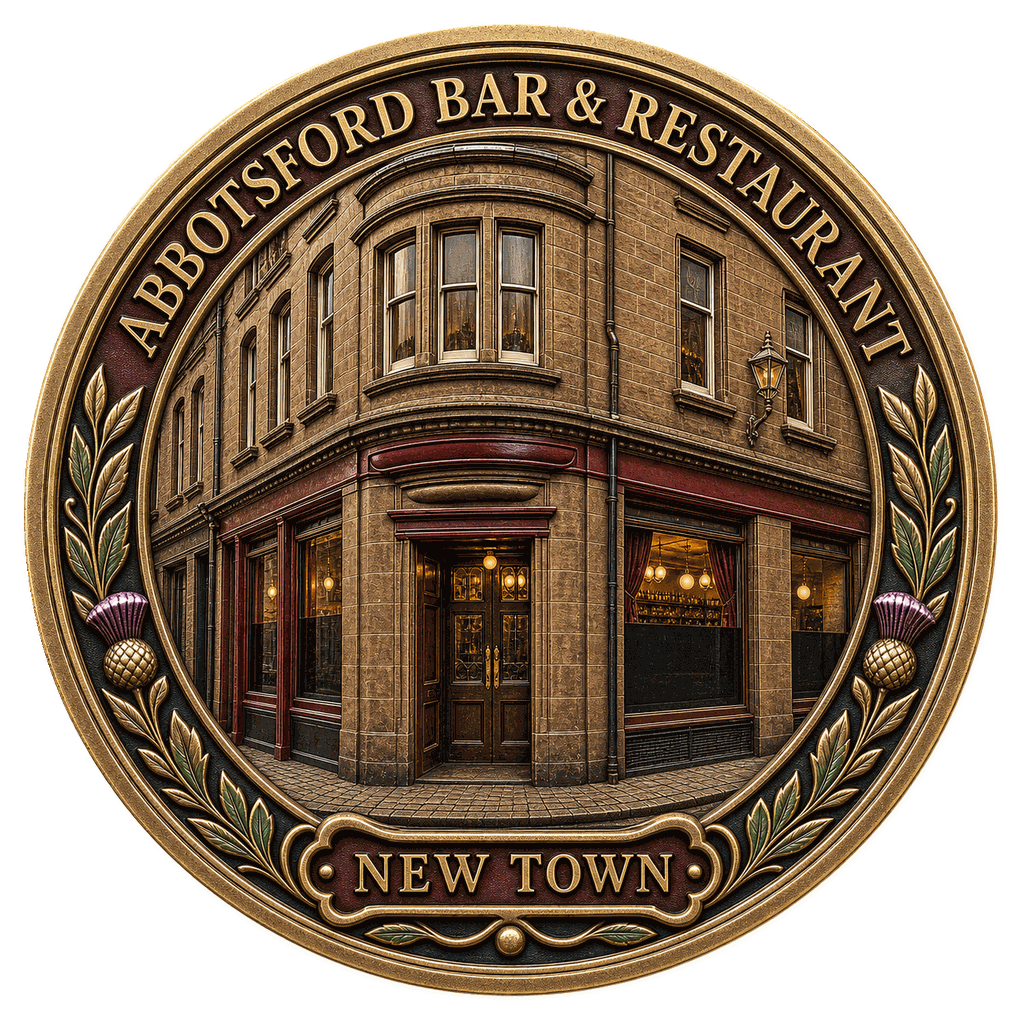
The present Abbotsford is a 1902 purpose-designed public house at 3-5 Rose Street, separate from an earlier opposite-side Abbotsford Arms reported in 1887. Historic Environment Scotland attributes the corner block to specialist pub architect Peter L. Henderson and records its ground-floor Jacobean Revival interior. CAMRA dates the mahogany island servery to the same 1902 scheme and gives the interior its Three Star national rating. Look beyond the counter to the carved superstructure, mirrored wall panelling, compartmented ornamental ceiling and surviving food servery. Archive catalogue entries for 1903-04 name the Abbotsford Arms public house and Messrs Charles Jenner & Co at this exact place, evidence of the business immediately after construction rather than a separate opening date. The room was not frozen in time: in the early 1970s the pub expanded upstairs, losing rear rooms to a new staircase, and the restaurant fittings above date from that phase. The operator says D. M. Stewart took over in 2006.
Literary connections
Each note states whether the link comes from a writer’s own words, a fictional setting, a commemorative name or a venue tradition.
Sir Walter Scott’s Abbotsford
Current pub identity
The present operator says the bar takes its name from Scott’s Borders home, Abbotsford. That is a commemorative naming link; it is not evidence that Scott used this Rose Street site.
- About — The Abbotsford Bar & Restaurant Operator account of the Scott/Abbotsford naming connection.
The Rose Street poets
Mid-20th century
The bar’s own history names Hugh MacDiarmid, Sorley MacLean and Sydney Goodsir Smith among its favoured literary visitors. A scholarly account also places regular meetings involving Goodsir Smith and MacLean here, but the venue’s wider roll-call remains its own account.
- About — The Abbotsford Bar & Restaurant Venue’s reported literary-regulars tradition.
- The Literary Culture of the Scottish Renaissance Scholarly contextual account of meetings involving Sydney Goodsir Smith and Sorley MacLean.
Alexander Moffat’s Poets’ Pub
1980
The Abbotsford is one of three pubs imaginatively combined in Moffat’s Poets’ Pub. The National Galleries explicitly describes the work as a composite, not a factual scene inside this venue.
- Poets’ Pub National Galleries description of the composite painting.
Ian Rankin and Iain Banks
Late 20th-early 21st century
The current operator reports both writers among more recent patrons. It is retained as a venue-reported association rather than presented as independently documented regular patronage.
- About — The Abbotsford Bar & Restaurant Venue-reported recent literary association.
What to notice
- 01
Study the island counter's carved superstructure: CAMRA notes that this 1902 servery unusually has no central island gantry.
- 02
Look up and around: the compartmented Jacobean Revival ceiling, mirrored panelling and etched 'The Abbotsford' door glass are recorded by HES.
- 03
Keep the phases straight: the rear-left food servery is original, but the staircase and upstairs restaurant fittings belong to the 1970s expansion.
From visitors

A visitor
The time rail
The building, the pub and its interior may date from different periods. The timeline keeps documented dates separate from tradition.
A reconstructed Abbotsford Arms is reported at 2-4 Rose Street, opposite the present bar.
Peter L. Henderson designed the no. 3-5 Rose Street corner block containing the Abbotsford Bar.
The mahogany island counter belongs to the present pub's 1902 interior scheme.
Archived accounts and papers name the Abbotsford Arms public house here for Messrs Charles Jenner and Co.
The pub acquired the first floor and inserted a staircase, removing earlier rear rooms.
The 3-9 Rose Street group including the Abbotsford Bar was listed at Category B as LB30151.
The operator says D. M. Stewart Ltd took over the Abbotsford.
Sources & confidence
HES separates the earlier opposite-side Abbotsford Arms from Peter L. Henderson's 1902 no. 3-5 block and its ground-floor Jacobean Revival pub, while also distinguishing the adjoining 1890 nos 7-9 workshop phase. CAMRA separately dates the island servery to 1902, records the original snack counter, gives the interior its Three Star national tier and documents the early-1970s staircase and first-floor restaurant conversion. Trove's shared HES record family adds exact-place coordinates and 1903-04 archive catalogue entries for Abbotsford Arms work for Messrs Charles Jenner and Co; those papers are not treated as an opening date. The operator verifies current details and attributes its takeover to 2006, but its claim that the 1887 Arms stood on this site conflicts with HES and is excluded. The workmen-wages motive, Spanish-mahogany provenance and named literary clientele also remain private rejected or uncorroborated claims. Official hours are a dated snapshot because CAMRA's surveyed food times differ.
Research reviewed
- 3-9 (ODD NOS) ROSE STREET, INCLUDING THE ABBOTSFORD BAR (LB30151)Historic Environment Scotlandheritage
SupportsStatutory identity, Category B designation and 12 December 1974 listing date; the distinct 1890 nos 7-9 workshop block; Peter L. Henderson's 1902 no. 3-5 block and ground-floor pub; Jacobean Revival interior, etched 'The Abbotsford' glass, island counter, decorative ceiling, panelling and 1970s first-floor conversion. It says the earlier Abbotsford Arms stood opposite, not on the present site.
- Edinburgh, 3, 5 Rose StreetTrove, Historic Environment Scotlandarchive
SupportsNRHE identity for 3 and 5 Rose Street, alternative name Abbotsford Arms, 20th-century public-house classification, WGS84 coordinates and catalogue references to 1903-04 accounts and papers for work on the Abbotsford Arms public house for Messrs Charles Jenner and Co. It shares the HES record family and does not itself state an opening date.
- Abbotsford Bar & Restaurant, EdinburghCampaign for Real Ale (CAMRA)specialist
SupportsCurrent specialist venue identity, exact address, postcode and telephone; Three Star nationally important historic-interior tier; 1902 island servery and surviving decorative fabric; original snack counter; early-1970s staircase and first-floor restaurant phase; current venue facilities and independently surveyed hours. Its workmen-spending-wages story is explicitly presented as a belief, not proof.
- About — The Abbotsford Bar & RestaurantThe Abbotsford Bar & Restaurantofficial
SupportsOperator account of the current public identity, Henderson's 1902 bar, island counter and decorative ceiling, D. M. Stewart's 2006 takeover and current operation. Its claim that the 1887 Abbotsford Arms stood on the present site conflicts with HES and is not used publicly; literary and Spanish-mahogany claims remain uncorroborated here.
- Contact Us — The Abbotsford Bar & RestaurantThe Abbotsford Bar & Restaurantofficial
SupportsChecked current visitor address, postcode, telephone, official website and published bar and food hours at final verification. It repeats promotional Edwardian, Spanish-mahogany and Jacobean wording but does not independently date or authenticate those details.
- Around St Andrew Square: a Geoheritage walk in EdinburghEdinburgh Geological Societyspecialist
SupportsProperty-specific specialist identification of the Abbotsford Bar on the north side of Rose Street as a 1902 Charles Jenner building, plus the bright red cross-bedded Permian sandstone from Gatelawbridge. It addresses building stone and date, not business continuity or interior originality.
- John Rigg the Abbotsford Arms Rose StreetOld Glasgow Pubseditorial
SupportsSecondary account placing John Rigg's Abbotsford Arms at 2-4 Rose Street and describing a September 1887 reconstruction banquet. It gives no visible citation to the underlying contemporary item, so the date remains attributed and is used only with HES's independent opposite-side location.